Electronics Sourcing Advisor
How to use: Select the primary requirement for your electronics purchase below to see which global hub best matches your needs.
Industrial Reliability
Factory lines, medical imaging, power grids
Cutting-Edge Tech
OLED displays, AI chips, high-end CPUs
Value for Money
Smartphones, IoT, budget gadgets
Extreme Precision
Robotics, high-end sensors, optics
Rapid Prototyping
Custom PCB design, fast iteration
Scale Assembly
Mass consumer electronics, mobile phones
Key Takeaways for Your Next Purchase
- Japan and South Korea: Lead in high-end semiconductors, sensors, and precision robotics.
- China: Unbeatable in scale, speed, and mid-range consumer electronics integration.
- Germany: The gold standard for industrial automation and heavy-duty electrical engineering.
- USA: Focuses on the "brains" (chip design and software) rather than the physical assembly.
- India: Rapidly climbing the ladder in smartphone assembly and consumer electronics.
The Precision Powerhouses: Japan and South Korea
If you need something that won't break for twenty years, you look toward East Asia. Japan is a global leader in precision engineering and high-quality electronic components. They don't just make the final product; they make the machines that make the products. Think of companies like Fanuc or Keyence. Their focus is on the "tolerances"-the tiny margins of error. If a part needs to be accurate to a micron, Japan is where it's made.
South Korea, led by giants like Samsung and LG, has perfected the art of the display and the memory chip. Their quality isn't just about durability, but about pushing the boundary of what's possible with OLED technology and NAND flash memory. When you buy a high-end TV, the panel is almost certainly a product of Korean engineering excellence. The synergy between their chemical industry and electronics manufacturing allows them to iterate faster than almost anyone else.
The Scale King: China's Manufacturing Ecosystem
You can't talk about quality without talking about the "ecosystem." China is the world's largest producer of consumer electronics, utilizing an incredibly dense network of suppliers. The "quality" in China isn't a single setting; it's a sliding scale. You can get a $10 gadget that breaks in a week, or a $2,000 server that runs a global bank. The secret is the Shenzhen ecosystem.
In Shenzhen, a designer can sketch a circuit board in the morning and have a physical prototype by the evening because every single component-capacitors, resistors, screens-is manufactured within a few square miles. This proximity reduces shipping errors and allows for rapid quality control loops. While they used to be seen as a source of cheap clones, Chinese firms like DJI and Xiaomi have proven they can lead the world in drone technology and smart home integration.
| Region | Core Strength | Quality Driver | Typical Products |
|---|---|---|---|
| Japan | Precision Components | Engineering Rigor | Sensors, Robotics, Audio |
| South Korea | Display & Memory | R&D Investment | Smartphones, OLED Panels |
| China | Mass Assembly | Supply Chain Density | Laptops, IoT Devices, Drones |
| Germany | Industrial Tech | Material Science | PLC, Medical Imaging, Power |
| USA | Chip Design (Fabless) | Software Integration | CPUs, GPUs, Cloud Hardware |
| India | Consumer Assembly | Scale & Cost Efficiency | Mobile Phones, Tablets |
Industrial Reliability: The German Approach
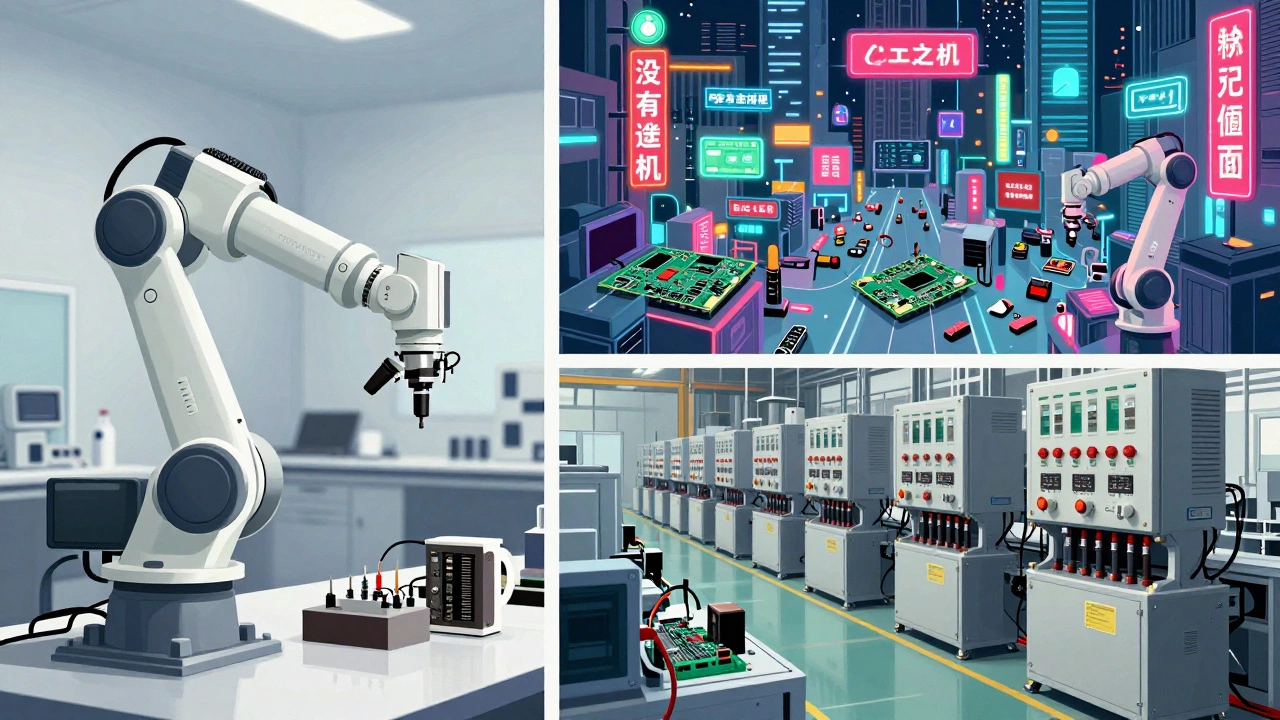
While consumer gadgets get all the hype, the electronics that keep the world running-power grids, automotive ECUs, and factory lines-mostly come from Germany. Their approach to electronics is less about "features" and more about "reliability." This is where Industry 4.0 was born, integrating the Internet of Things (IoT) with traditional heavy manufacturing.
German electronics are designed for the harshest environments. If a device needs to operate at 60 degrees Celsius in a dusty steel mill for a decade without a reboot, it's likely German-made. They prioritize high-grade materials and rigorous testing over aesthetic appeal. This is why a Siemens industrial controller is priced significantly higher than a consumer-grade equivalent; you're paying for the certainty that it won't fail.
The Rising Giant: Electronics Manufacturing in India
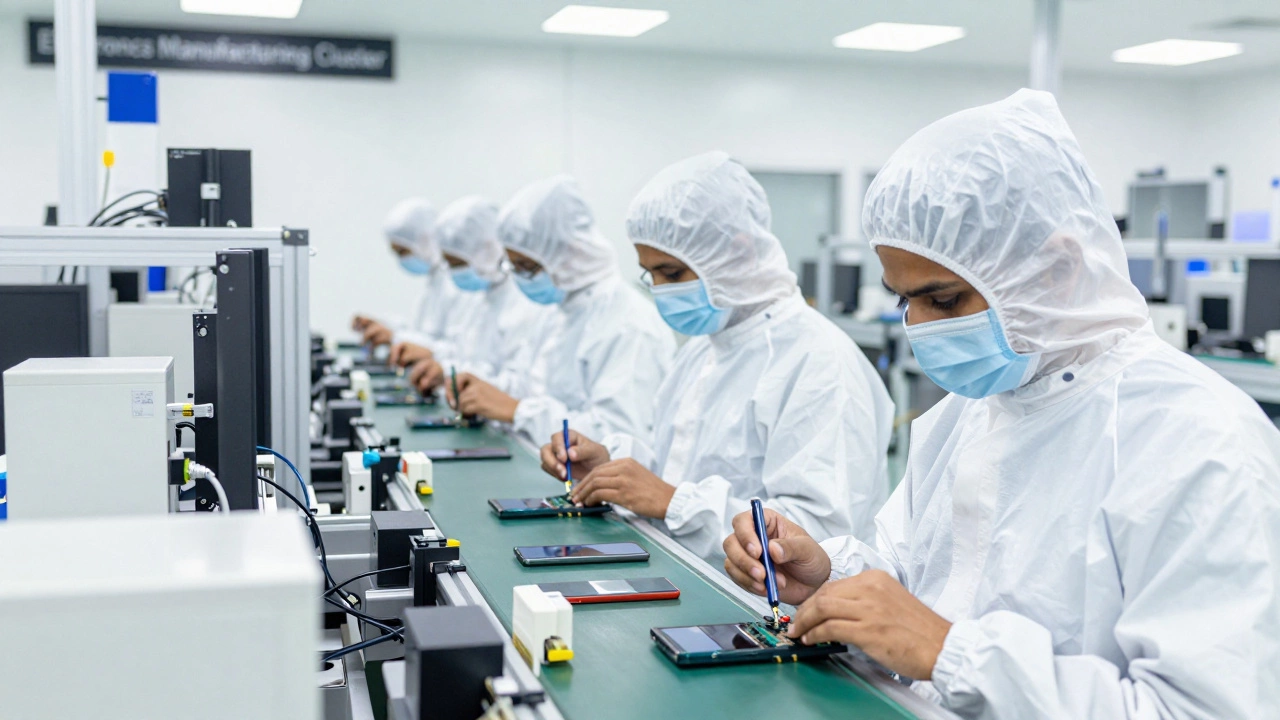
For years, India was primarily a software hub. But the tide has shifted. The country is now aggressively moving into hardware. Electronics manufacturing India has seen a massive surge, particularly in the mobile phone segment. It's no longer just about assembling parts imported from elsewhere; there's a push toward "Deep Tech" and domestic component manufacturing.
The shift is driven by a combination of a young workforce and government incentives. The Production Linked Incentive (PLI) scheme is a game-changer. It basically tells global companies: "If you manufacture here and hit specific sales targets, we'll give you a percentage of your incremental sales as a cash incentive." This has led companies like Apple's partners (Foxconn and Wistron) to shift significant portions of their production lines to Indian soil.
But is the quality there? In the beginning, there were hiccups with yield rates (the percentage of non-defective products). However, as the workforce has upskilled and the infrastructure-like the dedicated electronics manufacturing clusters (EMCs)-has improved, the gap has closed. India's quality is now competitive in consumer electronics, and the focus is shifting toward semiconductors and PCB (Printed Circuit Board) fabrication to reduce reliance on imports.
The "Fabless" Model: How the USA Wins
You might ask why the USA isn't on the list for "making" electronics. It's because the USA pioneered the Fabless Semiconductor model. Companies like NVIDIA, Qualcomm, and AMD don't actually own the factories (fabs) where the chips are printed. Instead, they do the incredibly complex work of architecture and design.
The actual physical manufacturing is often outsourced to TSMC in Taiwan. This means the "best quality" chip in the world is a hybrid: American intellectual property manufactured with Taiwanese precision. This separation of design and fabrication allows the US to maintain a lead in innovation while the physical production happens in regions with the best manufacturing infrastructure.
Avoiding the "Quality Trap"
When shopping for electronics, don't just look at the country of origin. Look at the components. A laptop assembled in China might use a Japanese capacitor, a Korean screen, and an American processor. The quality is a result of the global supply chain, not just the final assembly point.
One pro tip: check the certification marks. Look for UL (Underwriters Laboratories), CE (Conformité Européenne), or BIS (Bureau of Indian Standards) marks. These certifications mean the product has met specific safety and quality benchmarks, regardless of whether it was made in a high-tech park in Seoul or a factory in Tamil Nadu. If a device lacks these marks, the "country of origin" doesn't matter-it's a risk.
Is Indian-made electronics quality as good as Chinese-made ones?
In the smartphone and tablet category, yes. Because most Indian factories use the same global blueprints and machinery as Chinese factories, the final product is virtually identical. The difference lies in the "domestic value addition"-how many parts are actually made in India versus imported. As India builds more local component factories, the overall quality control will become more integrated.
Why is Japan still considered the best for sensors?
Japan has a long history of "monozukuri" (the art of making things). They specialize in the materials science required for sensors-things like specialized ceramics and rare-earth magnets. Their ability to maintain extreme precision at a microscopic level is still unmatched, which is why most high-end cameras and industrial robots rely on Japanese sensors.
Does "Assembled in [Country]" mean the quality is from that country?
Not necessarily. Assembly is the final stage. The quality of the internal components (the capacitors, the processor, the screen) is what determines the lifespan of the device. A product assembled in India might use components from Japan and Korea, meaning the quality is a global effort.
Which country is best for budget electronics?
China remains the leader for budget electronics due to their unmatched supply chain density. They can produce a vast variety of goods at a low cost without sacrificing basic functionality. However, India is quickly becoming a strong competitor in the budget smartphone market due to lower labor costs and government subsidies.
What is the role of Taiwan in global electronics quality?
Taiwan is the world's foundry. Through TSMC, they produce the most advanced semiconductors using the smallest nanometer processes. Without Taiwan, almost every high-quality electronic device-from iPhones to AI servers-would cease to exist or drop significantly in performance.
Next Steps: How to Choose Based on Your Needs
If you are sourcing components for a business or buying a high-ticket item, use this decision tree:
- For Industrial Reliability: Prioritize German or Japanese brands. Look for "Industrial Grade" certifications.
- For Cutting-Edge Consumer Tech: Look for South Korean or US-designed products.
- For Value-for-Money Gadgets: Chinese and Indian brands are the way to go. Compare the warranty terms, as that's often where the real quality difference lies.
- For Custom Prototypes: Shenzhen, China, is still the fastest place to turn an idea into a physical product.