Global Textile Market Share Simulator
Simulation Parameters
Adjust the slider to change the estimated total value of the global textile market (in billions USD) and see how it impacts India's export earnings.
Market Share Distribution
Financial Impact Analysis
Key Insight: Even with a massive global market, India's focus on high-value finished goods like denim and cotton yarn allows it to maintain a strong #2 position despite trailing China significantly in volume.
When you ask about the rank of India in textile manufacturing, it is a complex metric that shifts depending on whether you measure by total value, volume, or specific segments like cotton yarn versus finished garments. As of 2026, India consistently holds the position of the second-largest exporter of textiles and clothing globally, trailing only China. However, if we look at domestic production volume, India often ranks first in raw cotton production and second in total textile output. This distinction matters because exporting high-value finished goods is different from producing raw materials.
The Big Picture: Where Does India Stand Globally?
To understand the ranking, we need to separate the data into two main buckets: export value and production capacity. In terms of export value, the World Trade Organization (WTO) and the International Trade Administration report that India accounts for approximately 7-8% of the global textile trade. China remains the dominant player with roughly 35-40% market share. After China, India is the clear runner-up, followed by Vietnam, Bangladesh, and Turkey.
In 2025, India’s textile and apparel exports crossed the $45 billion mark, a significant jump from previous years driven by strong demand in the United States and Europe. The United States alone imports over $10 billion worth of Indian textiles annually. This makes India not just a producer, but a critical supplier for Western brands looking to diversify away from sole reliance on Chinese manufacturing.
| Rank | Country | Market Share | Key Strengths |
|---|---|---|---|
| 1 | China | ~38% | Scale, synthetic fibers, integrated supply chain |
| 2 | India | ~7.5% | Cotton, handlooms, ethical manufacturing, denim |
| 3 | Vietnam | ~4% | Garment assembly, trade agreements |
| 4 | Bangladesh | ~3.5% | Low-cost labor, ready-made garments |
| 5 | Turkey | ~2.5% | Proximity to EU, fast fashion response |
Why India Holds the Number Two Spot
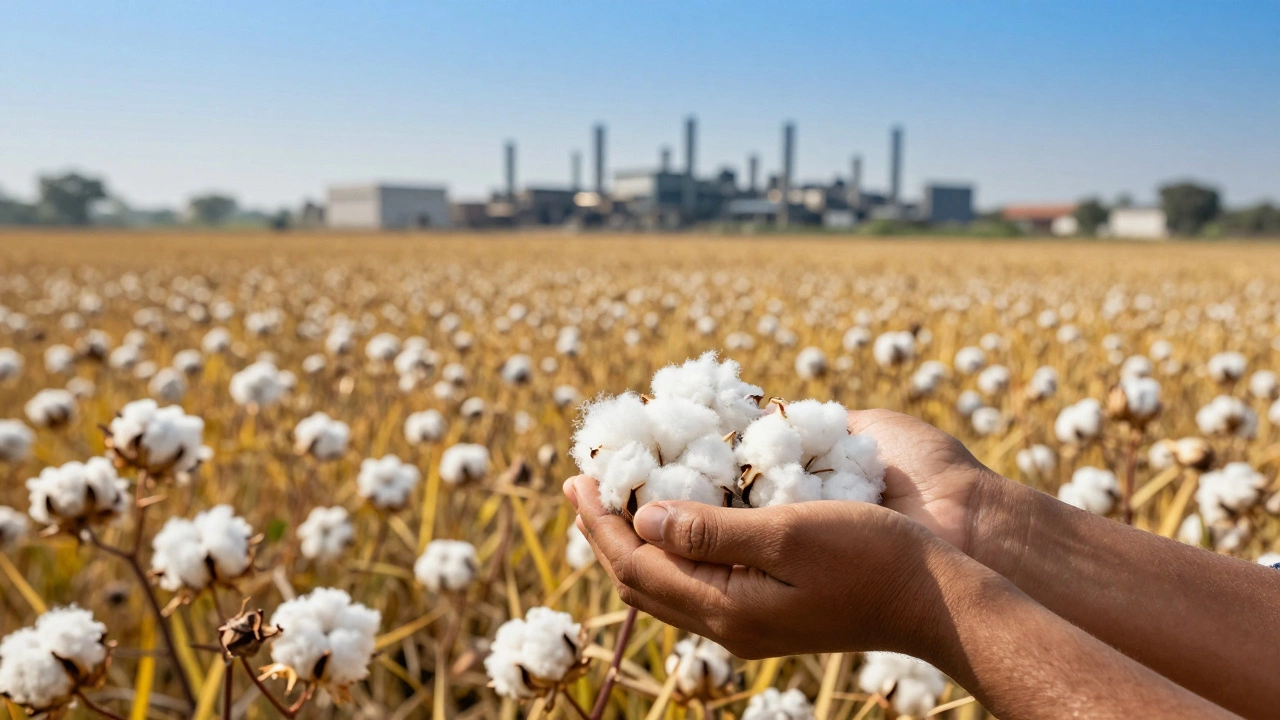
India’s ranking isn’t an accident; it’s built on a unique combination of resources that few other countries can match. First, India is one of the world’s largest producers of raw cotton, which is the primary natural fiber used in textile manufacturing, accounting for about 25% of global production. With states like Gujarat, Maharashtra, and Telangana yielding massive harvests, India has a homegrown advantage that reduces dependency on imported raw materials. This vertical integration-from farm to fabric-is a key competitive edge.
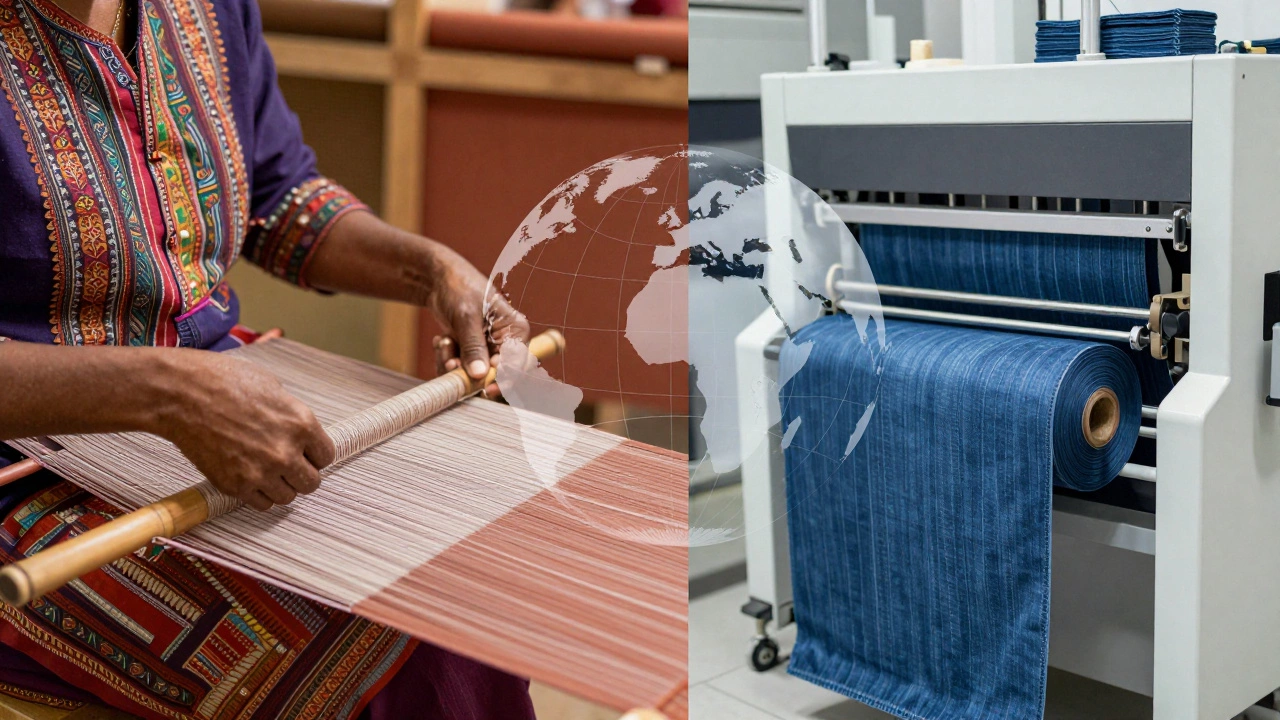
Second, the diversity of the industry plays a huge role. Unlike some competitors who focus almost exclusively on synthetic fast fashion, India excels in both traditional and modern sectors. You have the handloom sector, which is a decentralized cottage industry employing millions of artisans and producing unique, culturally significant fabrics, coexisting with massive automated mills in cities like Surat and Tirupur. Surat alone produces more polyester yarn than many entire nations. This dual capability allows India to serve niche luxury markets as well as mass-market budget segments.
Segment-Specific Rankings: It’s Not Just One Number
If you dig deeper, the "rank" changes based on what exactly is being manufactured. Here is how India performs in specific categories:
- Cotton Yarn: India is the largest exporter of cotton yarn in the world. If you are buying spools of white thread, India is likely your top source.
- Denim: India ranks among the top three global suppliers of denim fabric. Brands like Levi’s and Wrangler source heavily from Indian mills due to the quality of indigo dyeing and weaving expertise.
- Synthetic Fabrics: While strong, India trails behind China and Indonesia in pure synthetic fiber production. China dominates this space due to its petrochemical infrastructure.
- Ready-Made Garments (RMG): Here, India faces stiff competition from Bangladesh and Vietnam. While India is #2 overall, Bangladesh often edges out India in low-cost t-shirt and basic apparel assembly due to lower labor costs. India competes better in higher-value, branded apparel.
Challenges Keeping India From Taking First Place
You might wonder why India hasn’t overtaken China yet. Several structural hurdles remain. First, scale. China’s industrial ecosystem is unmatched. A factory in Guangdong can get a broken machine part replaced within hours because the entire supply chain exists nearby. In India, logistics and infrastructure gaps still add time and cost to the process.
Second, automation levels vary widely. While large players like Arvind Limited or Raymond are highly automated, a significant portion of the Indian textile industry relies on small-scale units with older machinery. This affects consistency and speed. Third, there is the issue of fragmentation. The industry is split between organized corporate houses and unorganized small enterprises. This makes it harder to implement uniform standards for sustainability and quality control, which Western buyers increasingly demand.
The Impact of Government Policy and PLI Scheme
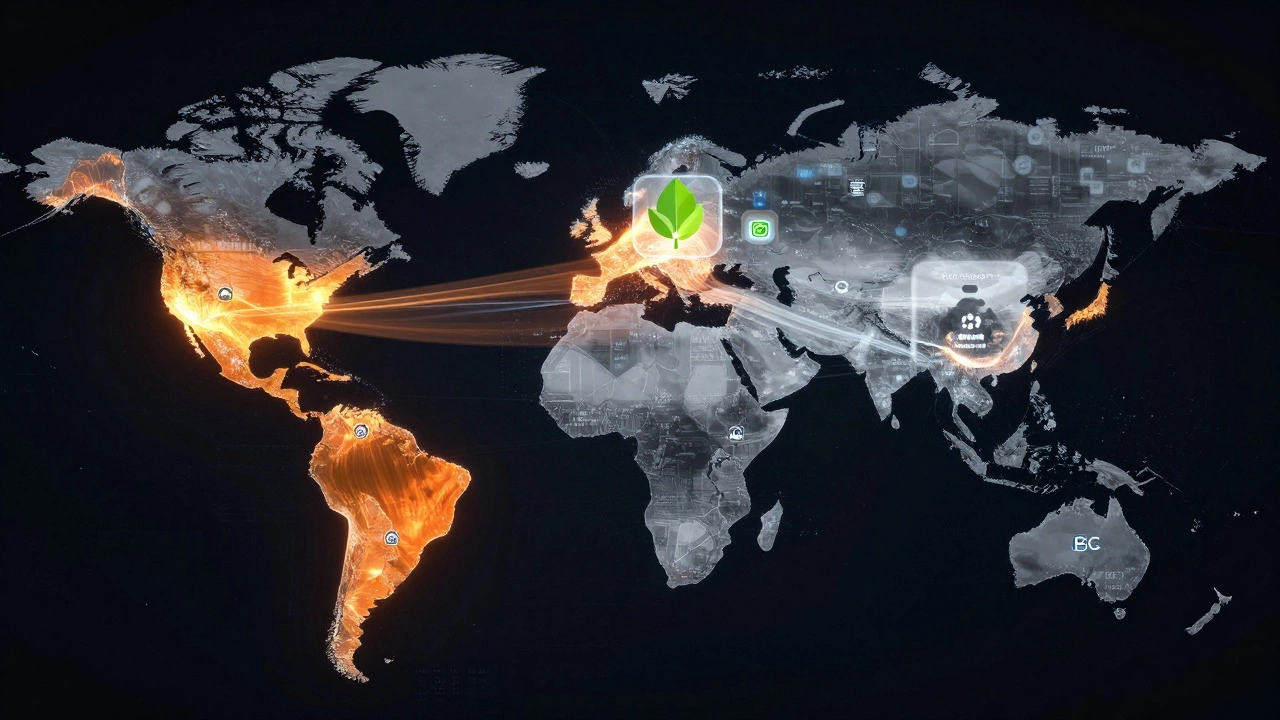
The landscape changed significantly with the introduction of the Production Linked Incentive (PLI) scheme, which is a government initiative providing financial incentives to manufacturers for increasing production and exports in targeted sectors. Launched to boost the textile sector, the PLI scheme aims to attract investment and encourage large-scale manufacturing. Early reports suggest it is helping big brands set up dedicated facilities in India, aiming to create a "China Plus One" strategy where global companies keep China but add India as a secondary hub.
This policy support is crucial for maintaining and potentially improving India’s rank. By subsidizing capital expenditure on modern machinery, the government is trying to close the technology gap with China. Additionally, free trade agreements (FTAs) with countries like Australia and ongoing negotiations with the European Union could further boost export volumes, potentially pushing India’s market share closer to 10% in the coming years.
Future Outlook: Can India Climb Higher?
Looking ahead to 2027 and beyond, India’s rank is poised to solidify, if not improve. The shift towards sustainable fashion works in India’s favor. Consumers in Europe and North America are demanding organic cotton and ethically produced garments. India leads in organic cotton certification, with thousands of farmers certified under Global Organic Textile Standard (GOTS). This gives Indian exporters a premium positioning that Bangladesh or Vietnam struggle to replicate at scale.
Furthermore, the rise of nearshoring and friend-shoring trends means Western brands want reliable partners outside of geopolitical hotspots. India’s political stability and democratic framework make it an attractive long-term partner. If India can streamline its logistics-through better port efficiency and inland waterways-it could reduce lead times significantly, making it even more competitive against Vietnam.
Is India the largest textile manufacturer in the world?
No, China is the largest textile manufacturer and exporter in the world. India ranks second globally in terms of export value and total textile output. However, India is the largest producer of raw cotton and the largest exporter of cotton yarn.
What percentage of the global textile market does India hold?
India holds approximately 7% to 8% of the global textile export market. This share fluctuates slightly year by year based on currency exchange rates and global demand, but it has remained stable around this figure for the past decade.
How does India compare to Bangladesh in textiles?
Bangladesh is a stronger competitor in low-cost, high-volume ready-made garments like t-shirts and underwear due to cheaper labor. India is stronger in higher-value products, denim, home textiles, and technical fabrics. India also has a more diversified economy and greater access to raw cotton.
Which countries buy the most textiles from India?
The United States is the largest buyer, followed by Germany, Italy, and the United Kingdom. The US market accounts for nearly 20-25% of India’s total textile exports, driven by demand for denim, shirting fabrics, and home furnishings.
Will India surpass China in textile manufacturing soon?
It is unlikely in the short term. China’s scale, infrastructure, and dominance in synthetic fibers are too entrenched. However, India may capture a larger share of the global market as brands diversify their supply chains to reduce risk, a trend known as "China Plus One."