Manufacturing System Selector
Assess Your Production Needs
Select the options that best describe your current or planned operation.
Recommended System
Why this fits?
Fill out the form on the left to see which manufacturing system matches your business profile.
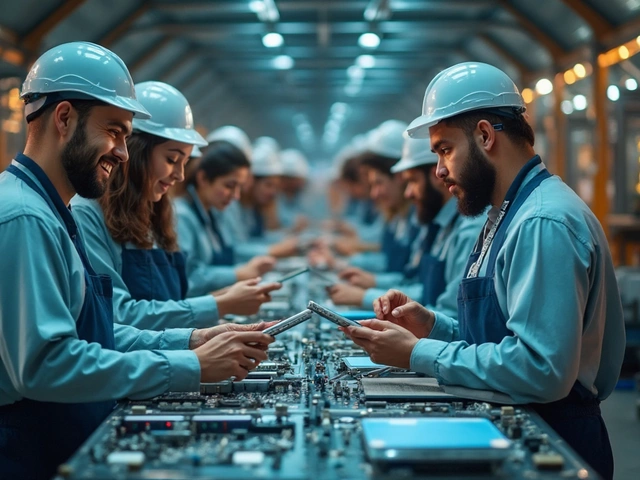
You walk into a factory floor. On one side, a massive stamping press hammers out car doors every four seconds. On the other, a small team assembles custom circuit boards for medical devices. Both are manufacturing, but they operate on completely different logic. If you’re trying to figure out which system fits your business idea, or just curious about how the world’s goods actually get made, you need to understand the core types of manufacturing systems. While there isn’t one single "most common" system across all industries globally-because it depends entirely on what you’re making-the Job Shop model is arguably the most widespread in terms of sheer number of facilities, especially among small and medium enterprises (SMEs) in the UK and beyond.
Why does this matter? Because picking the wrong system kills margins. If you try to run a high-volume product like plastic water bottles through a job shop setup, you’ll bleed money on setup times. If you try to make bespoke aerospace parts on a continuous flow line, you’ll spend more time reconfiguring machines than building parts. Let’s break down the main players, how they work, and which one likely dominates the landscape you’re looking at.
The Four Pillars of Production Logic
Most manufacturing operations fall into four buckets. Understanding these helps you diagnose why a factory looks the way it does. The classification usually hinges on two factors: volume (how many units) and variety (how many different types of products).
| System Type | Volume | Variety | Flexibility | Typical Example |
|---|---|---|---|---|
| Job Shop | Low | High | Very High | Custom machine shops, print shops |
| Batch Processing | Medium | Medium | Moderate | Bakeries, pharmaceutical tablets |
| Mass Production | High | Low | Low | Automobile assembly lines |
| Continuous Process | Very High | Very Low | Very Low | Oil refineries, paper mills |
Job Shop: The King of Small Business
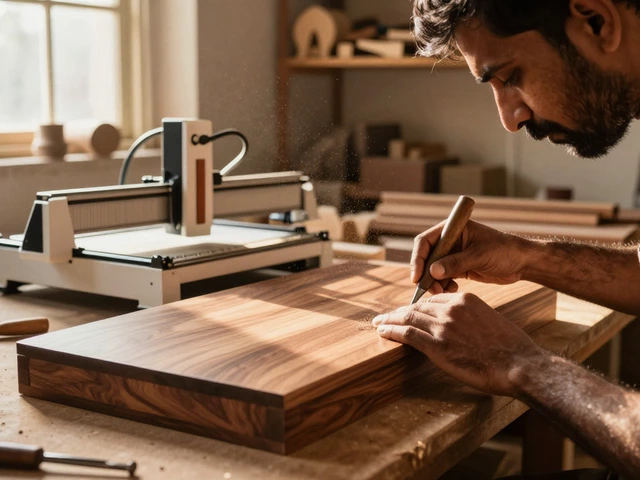
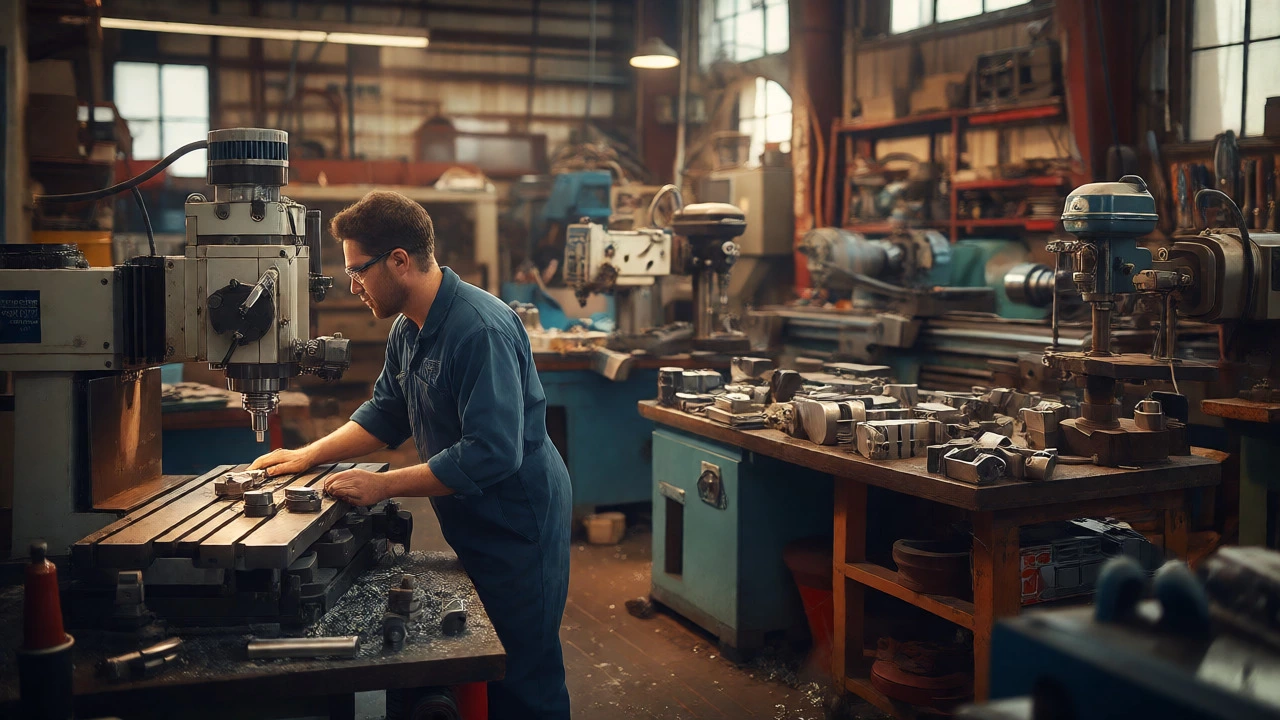
If you count every garage workshop, local CNC machining center, and boutique electronics assembler, the Job Shop wins by volume of businesses. This system handles low volumes of highly customized products. Think of a company that makes specialized brackets for wind turbines. Each order might be slightly different. The machines aren’t arranged in a straight line; they’re grouped by function-all lathes here, all milling machines there.
The advantage? Flexibility. You can switch from making part A to part B with minimal downtime. The downside? It’s slow per unit. Setup times eat up hours. Labor costs are higher because operators need to be skilled enough to handle varied tasks. In the UK, where SMEs make up 99% of businesses, this is the default setting for most non-commodity manufacturers.
Batch Processing: The Middle Ground
Batch processing is what happens when you have too much demand for a job shop but not enough for a dedicated assembly line. You produce a set quantity-a "batch"-of identical items, then stop, clean or reconfigure the line, and start the next batch. This is huge in food and pharma.
Consider a bakery. They don’t bake one loaf at a time (job shop), nor do they bake 10 million loaves continuously without stopping (continuous). They bake 500 sourdoughs, then 500 baguettes. This allows for some variety while maintaining better efficiency than a job shop. However, you deal with inventory buffers between batches, which ties up cash.
Mass Production: The Assembly Line Standard
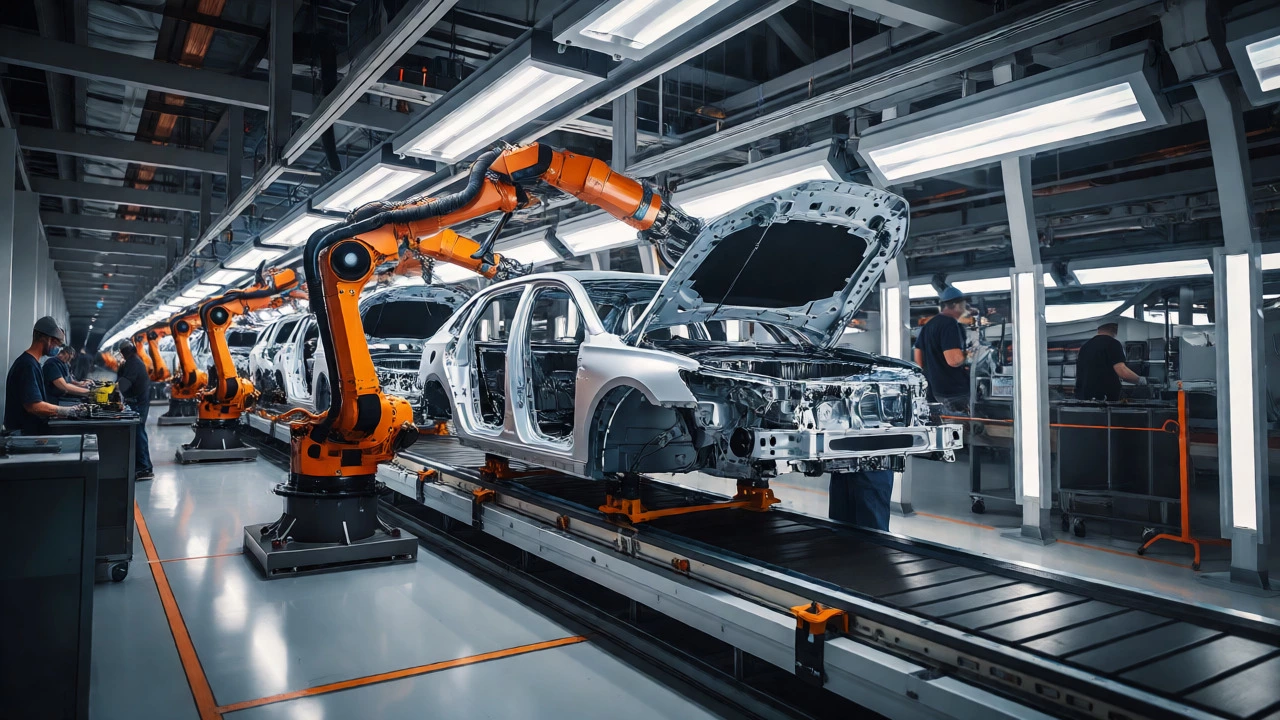
This is what most people picture when they hear "factory." Mass Production involves high volumes of standardized products. The layout is product-oriented: machines are arranged in the sequence of operations needed to build the product. Workers often perform repetitive tasks.
The classic example is the automotive industry. Henry Ford didn’t invent the car, but he perfected the moving assembly line, reducing chassis assembly time from 12 hours to 93 minutes. Today, even electronics follow this model. Apple doesn’t hand-build iPhones; they move along lines where robots and humans add components in strict order. Efficiency is king here. Unit costs drop dramatically as volume rises. But if you want to change the design? Good luck. Re-tooling takes weeks or months.
Continuous Process: Flowing Non-Stop
At the extreme end of volume lies Continuous Process manufacturing. Here, materials flow through the plant 24/7. There’s no distinct "unit" until the very end. Oil refining, steel smelting, and chemical plants use this.
You don’t turn these plants off easily. Shutting down an oil refinery costs millions and takes days to restart. Therefore, reliability is critical. Maintenance is scheduled during rare shutdown windows. Product variety is almost zero-you’re making one thing, constantly. This system has the lowest labor cost per unit but requires massive capital investment.
Which One Is Actually "Most Common"?
The answer depends on your metric. If you mean "which system is used by the most companies," it’s the Job Shop. Why? Because customization drives profit in niche markets. Everyone needs a specific part, a custom logo, a tailored solution. There are thousands of small manufacturers serving these needs.
If you mean "which system produces the most physical goods by weight or value," it’s Continuous Process or Mass Production. Think about it: billions of plastic bottles, tons of steel, millions of cars. These dominate global trade volume. But in terms of facility count, especially in developed economies like the UK, the fragmented nature of supply chains means small, flexible job shops outnumber giant factories.
A recent survey by the Confederation of British Industry (CBI) highlighted that over 60% of UK manufacturing firms cite "flexibility" as their key competitive advantage. That flexibility comes from job shop or batch models. Large multinationals use mass production, but they are fewer in number.
Hybrid Models: Where Reality Lives
Pure systems rarely exist in isolation. Most modern factories mix approaches. This is called Cellular Manufacturing, a hybrid strategy. Imagine a furniture maker. They might use a job shop approach for custom orders but run a cellular line for standard sofa frames.
Cells are groups of machines and workers organized to produce a family of similar parts. It reduces travel time for materials compared to a traditional job shop layout. It’s a smart compromise: better flow than a job shop, more flexibility than a pure assembly line. Many UK manufacturers adopt this to stay competitive against low-cost imports.
How to Choose Your System
Don’t pick a system because it sounds impressive. Pick it based on your data. Ask yourself three questions:
- What is my demand forecast? If you sell 10 units a month, go Job Shop. If you sell 100,000, look at Mass Production.
- How much variation do I have? If every customer wants a different color or size, Batch or Job Shop works best. If everyone wants the same blue widget, Mass Production wins.
- What is my capital available? Continuous processes require heavy upfront investment. Job shops rely more on skilled labor and versatile machines.
For startups, the trap is trying to scale too fast. You might set up a semi-automated line thinking you’ll hit mass volumes, only to realize your market is still testing your product. Start with a job shop mindset-keep it flexible. As your SKU stabilizes and volume grows, transition toward batch, then cell, then line.

The Role of Technology in Shifting Norms
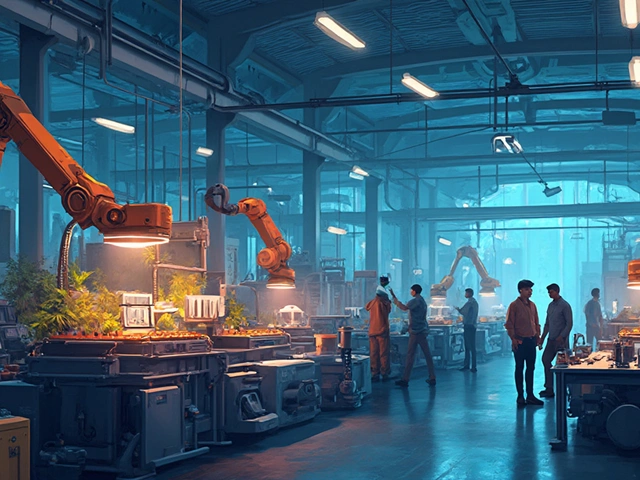
Industry 4.0 is blurring these lines. Advanced robotics and AI allow "mass customization." You can now run a line that changes settings automatically for each unit, effectively bringing job shop flexibility to mass production speeds. Adidas, for instance, uses automated knitting machines that can create different shoe designs on the same line without stopping. This challenges the old rule that high variety equals low speed.
However, the fundamental economics remain. You still pay for complexity. The question isn’t whether technology exists-it’s whether you can afford the integration costs. For most SMEs, sticking to proven batch or job shop methods with digital tracking tools (like ERP software) offers the best ROI right now.
Frequently Asked Questions
Is job shop manufacturing always less efficient than mass production?
Not necessarily. It is less efficient in terms of output per hour per worker for identical units. However, it is often more efficient in resource utilization for diverse products because it avoids the waste of unsold inventory. Mass production risks overproduction; job shops produce to order, reducing storage costs and obsolescence risk.
Can a small business use continuous process manufacturing?
Rarely. Continuous process requires enormous capital expenditure and steady, high-volume demand to justify the constant operation. A small business typically lacks the scale to keep such a plant running efficiently 24/7 without significant idle capacity or stockpiling issues.
What is the difference between batch and mass production?
The key difference is continuity and changeover. Batch production stops periodically to switch products, leading to setup times and partial utilization. Mass production runs continuously with minimal changeovers, aiming for maximum throughput of a single or very few product variants. Batch allows for moderate variety; mass production sacrifices variety for speed.
How does government support influence manufacturing system choice?
Government schemes often subsidize automation and energy efficiency. This can make mass production more accessible to smaller firms by lowering the barrier to entry for expensive machinery. Conversely, grants for innovation may encourage job shops to adopt advanced tech, allowing them to compete with larger entities through precision rather than volume.
Which manufacturing system is best for sustainability?
Job shops can be more sustainable regarding waste reduction since they produce to order, minimizing dead stock. However, continuous processes are often more energy-efficient per unit due to optimized thermal management and reduced start-stop cycles. The "best" depends on whether your primary environmental impact is material waste or energy consumption.